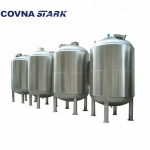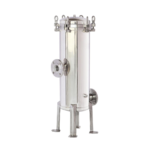
For water treatment system integrators and industrial distributors, the pressure vessel is not just a container; it is the foundation of the entire filtration process. Whether you are building a commercial water softener, a multimedia filter, or an industrial RO pre-treatment skid, selecting the correct tank configuration is critical. A mismatch in vessel sizing or connection type can lead to flow bottlenecks, plumbing incompatibility, and long-term maintenance failures.
The market offers a wide array of options: Fiberglass Reinforced Plastic (FRP) versus Stainless Steel; Threaded connections versus Flanges; Top mounting versus Side mounting. For procurement managers, making the right choice often balances cost against performance.
In this engineering guide, Stark Water Tank leverages decades of manufacturing experience to clarify the Industrial Vessel Selection process. We will detail how to configure our standard Fiberglass (FRP) Tanks for general applications and identify the specific engineering triggers that necessitate an upgrade to our premium Stainless Steel Products.
Part 1: Configuring Your FRP Tank Connections
FRP vessels are the industry standard for 90% of water treatment applications due to their corrosion resistance and cost-efficiency. However, the "connection type" is where most errors occur. The opening size must match your system's design flow rate and control valve interface.
Scenario A: Commercial & Light Industrial (Small to Medium)
For systems with flow rates under 10 m³/h (typical for hotels, laundries, and boiler feeds), threaded connections are preferred for their compatibility with standard control valves (such as Fleck, Clack, or Runxin).
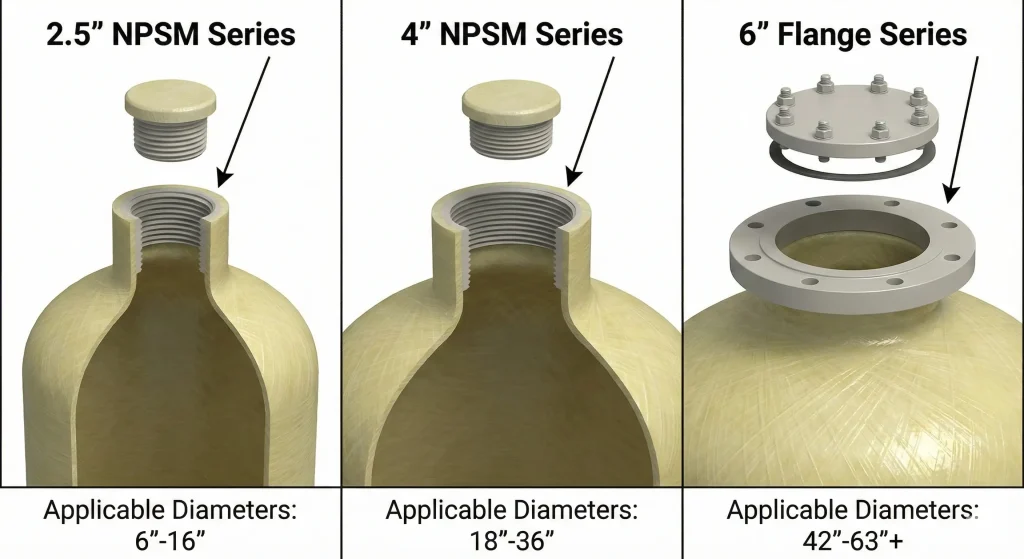
- 2.5" NPSM Threaded Series: Designed for tank diameters from 6" to 16". This is the universal standard for residential and light commercial softeners.
- 4" NPSM Threaded Series: Essential for tank diameters from 18" to 36". As the tank volume increases, the 4-inch opening is critical to allow for higher service flow rates and to facilitate the loading and unloading of heavy media like gravel or carbon.
At Stark, our Top Mount FRP Tanks feature a seamless, one-piece molded opening to ensure high-pressure integrity without leakage. You can view the full specification list here: View Top Mount FRP Tanks Specification.
Scenario B: Heavy Industrial (Large Flow Applications)
When system requirements exceed 15 m³/h, threaded connections become a restriction point. For industrial RO pre-treatment or municipal filtration, flanged connections are mandatory.
- 6" Flange Series: Available on tank diameters from 30" to 63".
- Why Flange? Threaded connections can crack under the vibration of large industrial pumps. A 6-inch flange provides a secure, bolted connection that withstands water hammer and physical stress, ensuring a robust seal for high-flow piping.
Part 2: The Upgrade Decision – When to Switch to Stainless Steel?
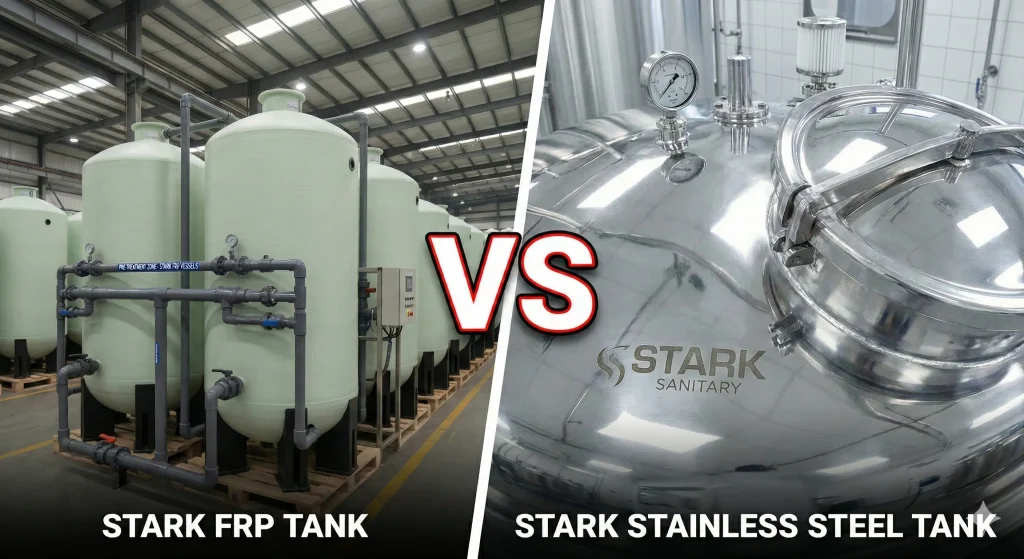
While FRP is excellent for salt brine and general cold water filtration, it has physical limitations. As a manufacturer of both composite and metallic vessels, we advise customers to upgrade to Stainless Steel if the application meets any of the following "Upgrade Triggers."
Trigger 1: Hygiene & Sanitary Requirements
In Food & Beverage, Pharmaceutical, or Cosmetics production, biofilm control is paramount. The internal surface of a standard FRP tank, while smooth, is not polished. For these industries, we recommend upgrading to Stark Stainless Steel Water Tanks.
The Solution: Our stainless steel vessels feature a polished internal finish (Ra < 0.4µm) that eliminates bacterial hiding spots, ensuring the water remains sterile.
Trigger 2: High-Temperature Applications
Standard FRP resin begins to lose structural integrity at temperatures above 49°C (120°F). If your process involves hot water sanitization (CIP) or high-temperature condensate return, FRP will fail.
The Solution: Stainless Steel (SUS304 or 316L) maintains structural strength well above 100°C. For clients who need the dimensions of an FRP tank but the thermal resistance of metal, we offer the unique "FRP-Style Stainless Steel Tank"—a drop-in replacement that fits your existing skid but handles the heat.
Explore our premium metal solutions here: View Stark Stainless Steel Product Series.
Part 3: Sizing Rules – Diameter vs. Flow Rate
Correct sizing prevents media channeling and pressure loss. Use this "Rule of Thumb" engineering table to match your required flow rate with the correct Stark vessel diameter.

| Tank Model | Dimensions (Dia x H) | Rec. Service Flow (Filter @ 12m/h) | Connection Type |
|---|---|---|---|
| 1054 | 10" x 54" | 0.6 - 1.0 m³/h | 2.5" Thread |
| 1665 | 16" x 65" | 1.5 - 2.5 m³/h | 2.5" / 4" Thread |
| 2472 | 24" x 72" | 3.5 - 5.0 m³/h | 4" Thread |
| 3672 | 36" x 72" | 8.0 - 10.0 m³/h | 4" Thread / 6" Flange |
| 6386 | 63" x 86" | 24.0 - 30.0 m³/h | 6" Flange |
Note: Flow rates are approximate based on standard sand filtration velocities. Softening applications may allow for higher velocities.
Why Source Factory Direct from Stark?
Customization Capabilities: Unlike trading companies that only offer standard catalogs, Stark Water Tank provides OEM customization. We can fabricate Stainless Steel Mixing Tanks with custom port locations or Side-Mount FRP tanks for specialized height restrictions.
Stock & Logistics: We maintain a massive inventory of standard shells (1054 to 3672) ready for immediate winding and assembly. This allows us to offer rapid lead times for urgent project replacements.
Conclusion: Secure Your System with the Right Vessel
Effective Industrial Vessel Selection is about balancing the chemical resistance of FRP with the thermal and sanitary durability of Stainless Steel. By choosing Stark, you gain access to both material technologies from a single manufacturing source.
Need a detailed technical drawing or a bulk pricing quote?
Send your system parameters (Flow, Pressure, Temperature) to our engineering team today. We will provide a comprehensive proposal including the optimal tank model and connection drawing.
Contact Stark Water Tank Experts